Month 3 - 3 months postpartum. How am I developing?
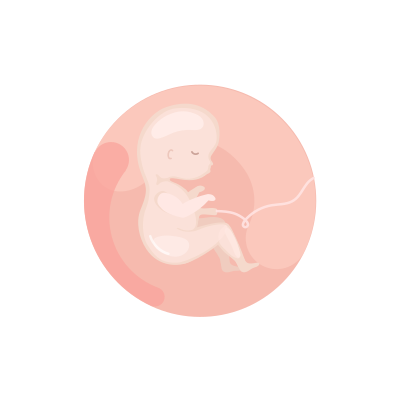
- This is the time of a developmental jump and intensive physical and mental changes.
- Due to the weakened tension of the lower esophageal sphincter the frequency of posseting might increase.
- After the stage of crying comes the stage of cooing. These are successive stages of speech development which occur between the first and third month of life.
- This is the time when colics can occur. Hard and bloated tummy, pulled-up legs, and redness of the face are indicative of this problem.
- I will start distinguishing between tastes and smells. It is connected to the developmental leap, which is called “the world of patterns”.
- I actively try to communicate with my nearest surroundings.
- When you hold me with my face pointing downwards I can keep my head aligned with my body.
Week 9. - What is my baby development at 9 week ?- I start to lift my head at a 45 degree angle to the ground.
- I’m unable to change my position on my own yet.
- I can keep my eyes in one position. I focus most often when you lean to face me.
- I react to loud noises, footsteps, and sounds from all around me.
- My movements are not coordinated yet. However, I still enjoy waving my arms and legs.
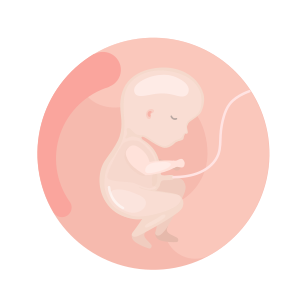 Week 10. - Newborn's 10. week - what to expect
- When lying on my back I take on a characteristic position called the fencing reflex.
- My fists are open more and more often and my fingers are straight. I’m beginning to discover my hands, which I will then start putting in my mouth.
- I start to smile back at you. This will be my first conscious smile.
- I begin to discover the world through different senses. My eyesight, hearing, and the sense of smell are all developing.
- Because of my intensive development I might demand more attention, be more hungry, and sensitive to stimuli from the environment.
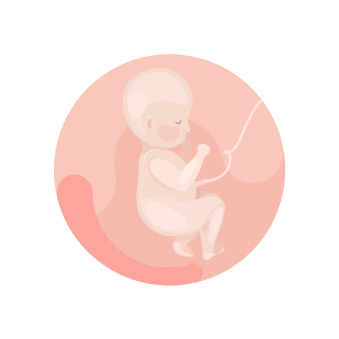 Week 11. - What happens the 11. week after birth?
- My range of emotions is constantly expanding. I will communicate my needs through different types of crying. You’re getting better at recognizing what each type means.
- I now need a lot of peace, routine, predictable activities, and the sense of safety.
- My sleeping patterns are slowly becoming more regular. You will soon be able to notice some rhythm in them. Unfortunately, I can’t promise you that it will stay that way.
- I intently listen to the sounds from my surroundings. I can hear and distinguish between different intonations.
- At this time you can hear velar sounds such as /g/, /k/, /ŋ/, as well as sounds resembling /r/. This is the stage of cooing so these particular sounds are random.
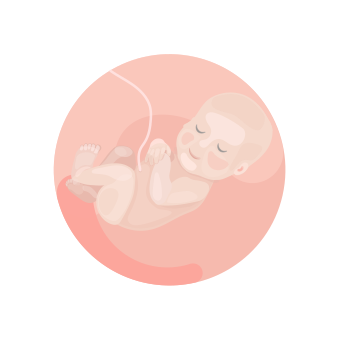 Week 12. - How is my baby development at 12 week?
- I enjoy looking at toys which are hanging over my head but I can’t do anything with them yet.
- I perk up during bathing or changing and you already know which activities I enjoy more than the other ones.
- First tears might appear thanks to the activity of the tear glands.
- I make sound which start to resemble vowels such as /ʌ/ and /e/, combined with /h/ to form “ha” or “ba”.
- Cooing is not used for communication. It’s involuntary and it disappears around month 6 when babbling starts.
The information provided is for educational purposes only and is not intended as medical advice. Always consult a qualified healthcare provider for diagnosis and treatment.